Increases data literacy and utilization across departments.
Balances autonomy with control, enabling federated or centralized governance models.
Accelerates time-to-value for data products and insights.
Supports compliance through traceability, lineage, and standardized workflows.
Alteryx enables flexible adoption of data mesh and data fabric principles, allowing CDOs to evolve architecture at the pace of organizational maturity while maintaining enterprise-wide alignment and control.
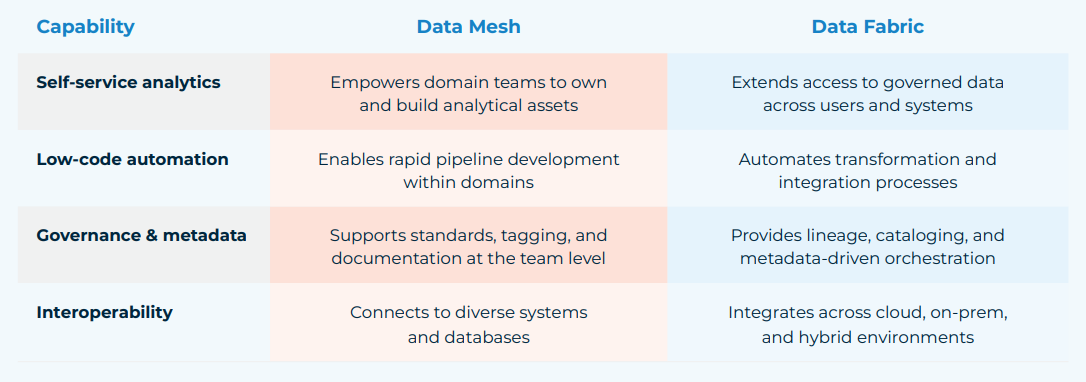
Chief Data Officers are tasked with transforming data into a trusted, governed, and accessible asset across the organization. As data volumes grow and business needs diversify, traditional centralized architectures often fail to keep pace. Two modern approaches — data mesh and data fabric — offer different pathways to achieving scalable, agile data ecosystems.
Understanding the Approaches
DATA MESH
Decentralized ownership: Data is managed by domain teams.
Data as a product: Each team ensures quality, discoverability, and usability.
Federated governance: Standards and interoperability are maintained across domains.
DATA FABRIC
Unified architecture: Connects distributed data through intelligent services.
Metadata-driven automation: Enables real-time data integration, lineage, and discovery.
Centralized oversight: Supports compliance, quality, and access across all data sources.
Increases data literacy and utilization across departments.
Balances autonomy with control, enabling federated or centralized governance models.
Accelerates time-to-value for data products and insights.
Supports compliance through traceability, lineage, and standardized workflows.
Alteryx enables flexible adoption of data mesh and data fabric principles, allowing CDOs to evolve architecture at the pace of organizational maturity while maintaining enterprise-wide alignment and control.